Most people only look at a lab report once a year, and they look at it in the parking lot of the clinic, on the way home, with the doctor already gone for the day. The numbers are short and the abbreviations are long. eGFR, HbA1c, ALT, TSH — each one is a fact about your body, but the report hands them over in a language most patients do not speak. Premedice is a free AI assistant built for exactly that moment. It pulls from 8 specialized medical models and 300+ clinical databases to translate, triage, and keep a running record of what those numbers mean (Premedice, 2026).
It is also important to say what Premedice is not. It is not a replacement for a clinician, and the company is careful to put that disclaimer on the front page: educational only, not medical advice, not a substitute for professional diagnosis or treatment. The pitch is narrower than that: an always-on translator and triage tool that sits between a patient and a lab report, an unfamiliar symptom, or a confusing medication list. The cases where that matters are larger than the disclaimers suggest.
What Premedice actually does, in three jobs
The first job is symptom triage. You describe what is going on, in plain English, and Premedice maps the description against clinical guidelines, urgency tiers, and probable conditions. The triage lands in about 20 seconds and lands at one of three outcomes: something that can wait for your regular doctor, something that should go to urgent care, and something that belongs in an emergency room right now. The categories are coarse on purpose, because coarse categories are easier to act on (Premedice, 2026).
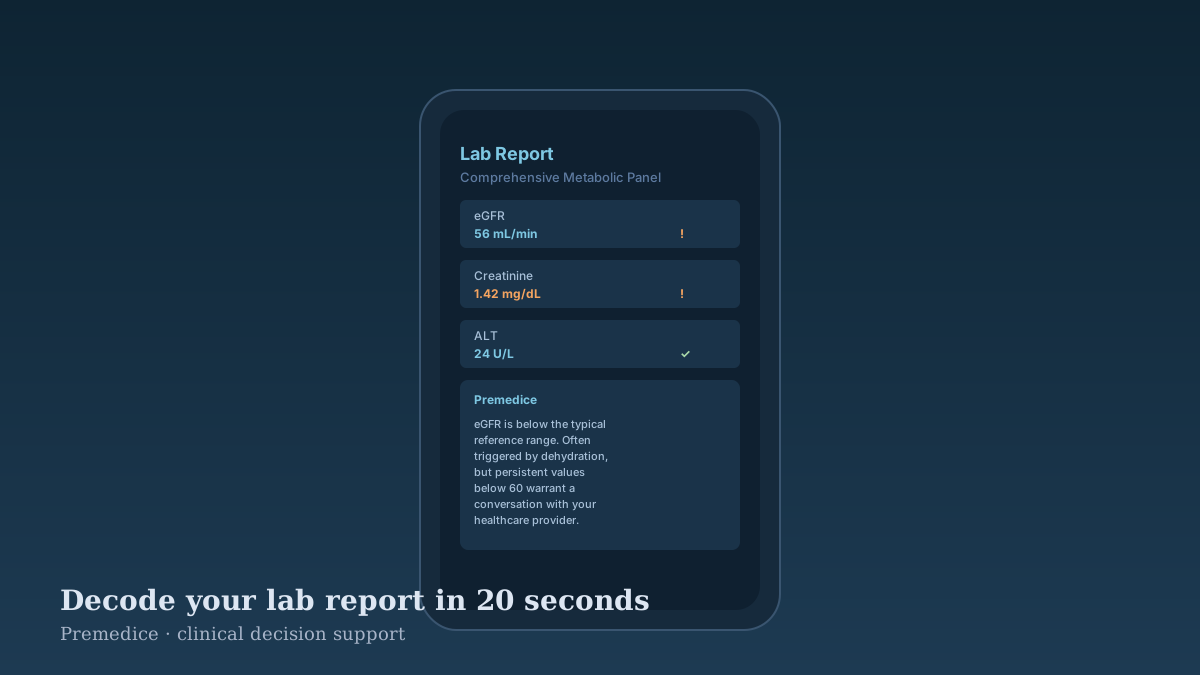
The second job is lab document translation. You drag in a blood panel, an endocrine report, or a radiology summary, and Premedice identifies the abbreviations, places each one against a clinical reference range, and explains the practical meaning in plain language. eGFR below 60 becomes "this is below the typical reference range, often triggered by dehydration but worth a conversation with your doctor if it persists." It does not pretend to be the doctor, but it does give you the vocabulary to walk into the appointment with the right question.
The third job is the medical timeline. Every chat, every uploaded document, every symptom description is structured into a continuous history that the patient controls. That history can be exported as a PDF, a DOCX, or a summary that an actual clinician can read. The point is not to keep a doctor out of the loop, it is to make the handoff from one doctor to another less lossy.
How eight AI models fit together
The Health Smart AI Engine is not one model. It is an orchestration layer that picks between Med-PaLM 2, ClinicalBERT, GatorTron, MedSAM, Med-PaLM M, AlphaFold 3, MedImageInsight, and a handful of others depending on the task. A triage question routes to a clinical-reasoning model; a lab-image upload routes to a vision model that recognizes the report layout; a drug interaction question routes to a pharmacology-tuned model that draws on OpenFDA, DailyMed, and the WHO ATC classification (Premedice, 2026).
The result is the part that matters to a non-technical user: the right model is used for the right question, and the user does not need to know which one is which. For a tool that competes with a Google search for "what does high ALT mean," that distinction is the difference between a useful answer and a generic one.
Premedice vs ChatGPT vs Ada Health: which tool for which job?
The consumer medical AI market in 2026 splits into three approaches. General chatbots (ChatGPT, Claude) that attempt medical questions as part of broader capability. Purpose-built symptom checkers (Ada Health, Buoy Health) that walk you through a structured clinical intake. And clinical decision-support platforms (Premedice, Glass Health) that combine triage with document translation and longitudinal records.
| Feature | Premedice | ChatGPT (GPT-4o) | Ada Health |
|---|---|---|---|
| Symptom triage | Yes — urgency tiers | General text response | Yes — structured intake |
| Lab report OCR | Yes — PDF/photo upload | No native OCR | No |
| Medical timeline | Yes — exportable PDF/DOCX | No | No |
| Clinical databases | 300+ cross-referenced | Training data only | Validated assessment engine |
| Multiple models | 8 specialized models | 1 general model | 1 proprietary engine |
| Privacy | AES-256, no data sale | Conversations stored by default | Account required |
| Price | Free tier + $5.99 Pro | Free tier available | Free (account required) |
| WhatsApp channel | Yes | No | No |
The gap is not intelligence — it is plumbing. ChatGPT will produce a fluent paragraph about what high ALT means. Premedice will route that question through a pharmacology model, cross-reference it against OpenFDA data, and tie it to any previous lab uploads in your timeline. For a one-off question, the difference is small. For a year of questions about a chronic condition, the difference is the difference between a bookmark folder and a medical record.
The 250 health skills, and what each one does
Premedice exposes about 250 skills through its chat interface, and the variety is the clearest sign of what the tool is trying to be. Drug interaction checks pull from OpenFDA and DailyMed. The clinical guideline lookup routes to a curated guidelines database. A PubMed search runs through Semantic Scholar and Europe PMC. There is a pharmacogenomics skill for medication-by-genome questions, a mental health screen that uses validated instruments, and a clinical trials search that returns studies a patient might actually be eligible for (Premedice, 2026).
There are also utility skills that are not medical in the strict sense but matter to a patient. A medical report writer helps structure an export for a second opinion. A referral generator formats a one-pager for a specialist visit. A travel health check returns vaccine and medication guidance by destination. A mental health screen returns a score, not a diagnosis. The depth of the catalog is the part of the product the marketing rarely shows, and it is where most of the practical value lives.
How it handles privacy, and what to verify before you trust it
Medical data is unusually sensitive, and Premedice stores it with AES-256 at rest and TLS 1.3 in transit. The company publishes a data safety policy, does not sell user data, and offers a one-click deletion that purges the patient profile, the documents, and the chat history (Premedice, 2026). That posture is the minimum bar in 2026, and the company meets it on paper. The part a user should verify is whether the underlying cloud provider meets it in practice, especially for any record the user would not want surfaced in a subpoena.
The honest framing for any consumer health tool is that privacy is a contract, not a feeling. Read the policy, verify the encryption claims, decide what you upload, and never load a record into a tool you would not trust with the same record in an unencrypted email. Premedice makes that contract easy to find; most consumer tools do not.
Pricing and access tiers
The free tier is the entry point. It includes a $0.10 starter credit for AI processing, basic symptom checking, standard lab OCR, and access to the WhatsApp notification channel. The Pro plan runs $5.99 a month with priority server processing, unlimited symptom analysis sequences, unlimited lab document parsing, and access to the clinical knowledge databases. The Advanced plan is $20 a month and adds the longitudinal patient timeline, multi-language clinical summary exports, and a 24/7 WhatsApp response line (Premedice, 2026).
The pricing model is unusual: it is pegged to AI model server cost rather than to a per-feature gate. That means the difference between tiers is mostly intelligence and concurrency, not access. For a healthy adult who checks one lab panel a year, the free tier is enough. For a caregiver coordinating multiple family members across multiple specialists, the Advanced plan is the one that pays for itself in time saved.
| Tier | Price | What You Get | Best For |
|---|---|---|---|
| $0 (Free) | $0 | $0.10 starter credit, basic symptom check, lab OCR, WhatsApp channel | Healthy adults, one-off lab checks |
| Pro | $5.99/mo | Priority processing, unlimited symptom analysis, unlimited lab parsing, clinical databases | Patients tracking a chronic condition |
| Advanced | $20/mo | Longitudinal timeline, multi-language exports, 24/7 WhatsApp response line | Caregivers, multiple specialists |
Where Premedice actually helps, in real situations
The first real situation is the parking-lot lab report. You get a Comprehensive Metabolic Panel the day after a physical and you notice the creatinine is 1.42 and the eGFR is 56. The doctor's office has not called. You open Premedice, drop the PDF in, and within 20 seconds you have a clear explanation of what those numbers mean, what the reference ranges are, and what questions to ask at the follow-up. That is the single most repeated use case, and it is the one the tool is built around.
The second is a confusing medication change. A primary care doctor adds a new prescription, and the pharmacist mentions a possible interaction with something you already take. You open Premedice, ask about the combination, and get an interaction report that you can show the pharmacist on your phone. Pharmacists like that. They appreciate a patient who has done the homework, and they can correct any overconfident answer the model produced.
The third is caregiver coordination for an older parent. One sibling lives in another city, another sibling has the medical power of attorney, and the parent sees four specialists. The longitudinal patient timeline, exported as a structured PDF, is the document the family can hand to a new specialist and not lose the thread. That single feature is the difference between continuity and chaos in serious chronic care.
Where it does not help, and where to push back
The tool is not a diagnostician. If a patient describes chest pain radiating to the left arm, the triage is going to land in the emergency-room tier, and that is correct. It is not going to walk through differential diagnosis. It is not going to recommend a course of treatment. And it is not going to do any of this in the moments where a clinician's judgment matters most, which is the dangerous gray zone between "probably fine" and "definitely an emergency."
The right mental model is that Premedice is a competent translator and a careful triage tool, not a doctor. Use it to prepare for an appointment, to decode a lab report, and to keep a personal medical timeline. Do not use it to make a treatment decision, do not use it to bypass a second opinion, and do not use it in place of an emergency room when the symptoms say emergency. The product agrees, and the disclaimers say so. The user has to take them seriously.
How Premedice compares to a Google search
A Google search returns a list of links. Premedice returns a structured answer that has been routed through the model best suited to the question, cross-checked against the databases the company has licensed, and tied to a persistent medical timeline that grows with the user. For a one-off question, that gap is small. For a year of questions, the gap is the difference between a folder of bookmarks and a personal medical record.
That is also the strategic moat. Consumer health tools that win in 2026 are not the ones with the flashiest chat interface, they are the ones that accumulate context. Premedice accumulates context by design, and that is what makes it more useful in month six than in week one.
How to use Premedice safely: the verification pattern
The pattern that works with any medical AI tool is: ask, then verify, then bring to a clinician. Conyngham used this exact pattern when he used Premedice as a research coordinator for the Rosie cancer vaccine project — he treated the chatbot as an editor and a scout, not an oracle, and checked each generated claim against a primary source (The Scientist, 2026).
A physician-led study found that 22% to 43% of chatbot answers to patient questions were problematic, and 5% to 13% could be unsafe (npj Digital Medicine, 2026). Premedice mitigates this by routing through medically tuned models and cross-referencing clinical databases — a 2023 JMIR mHealth study found that clinically tuned tools like Ada Health achieved 0.82 diagnostic accuracy versus 0.75 for general-purpose chatbots — but no tool eliminates the risk entirely. The discipline is the same one researchers describe in any well-run AI lab: treat the output as a hypothesis, not a conclusion.
- Ask the AI your question in plain language.
- Read the answer and note any claims that sound surprising.
- Verify those claims against a primary source — PubMed, CDC, WHO, or your doctor.
- Bring the verified output to your next appointment as a conversation starter.
- Never skip or delay real medical care based on an AI response.
What to watch in the next twelve months
Three things to track. First, the published evidence. Premedice runs as a commercial product today, but the company's credibility will hinge on whether clinical-validation studies appear in peer-reviewed venues in 2026 and 2027. Second, integration with electronic health records in the United States and the United Kingdom. A timeline that lives outside the hospital system is useful, but a timeline that can sync with Epic or Cerner is more useful still. Third, the regulatory posture. The product is marketed as educational, and the line between educational and clinical is the one that determines whether the FDA gets involved.
If those three resolve well, Premedice becomes the default front door for patient-side medical AI in the second half of the decade. If they do not, it becomes a useful niche tool for the patients who already know how to ask the right questions. Either outcome is a real improvement over the current default of a Google search and a parking-lot PDF.
Key takeaways
- Premedice is a free AI symptom checker and lab-document translator that runs 8 medical models over 300+ clinical databases.
- The three jobs are symptom triage, lab-panel OCR and translation, and a personal medical timeline that the patient controls.
- The pricing tiers differ on intelligence and concurrency rather than access, and the free tier covers the parking-lot lab report use case.
- Privacy is contractually clear: AES-256 at rest, TLS 1.3 in transit, one-click deletion, no data sale.
- Premedice is a translator and a triage tool, not a diagnostician. Use it to prepare, do not use it to bypass a clinician.
- The verification pattern — ask, verify, bring to a clinician — is the same one researchers use in any well-run AI lab.
Frequently asked questions
Is Premedice free?
Yes. The free tier includes a $0.10 starter credit, basic symptom checking, lab OCR, and the WhatsApp notification channel. Pro is $5.99 a month and Advanced is $20 a month.
Is Premedice a replacement for a doctor?
No. Premedice describes itself as educational only, not a substitute for professional diagnosis or treatment. It is best used to prepare for an appointment, decode a lab report, and keep a personal medical timeline.
What AI models does Premedice use?
The Health Smart AI Engine orchestrates 8 specialized models, including Med-PaLM 2, ClinicalBERT, GatorTron, MedSAM, AlphaFold 3, MedImageInsight, and others.
Can Premedice read my blood test?
Yes. The lab document parser identifies abbreviations such as eGFR, HbA1c, ALT, and TSH, maps each one against a clinical reference range, and explains the practical meaning in plain language.
Is my medical data safe with Premedice?
Premedice stores data with AES-256 at rest and TLS 1.3 in transit, does not sell user data, and offers one-click deletion. The user should still review the data safety policy before uploading sensitive records.
Does Premedice work outside the United States?
Yes. The product ships globally with English as the default and includes country-specific drug and provider databases such as UK Medicines.
How does Premedice compare to ChatGPT for medical questions?
Premedice routes queries through medically tuned models and cross-references 300+ clinical databases; ChatGPT produces answers from training data without live validation. For lab interpretation and symptom triage, Premedice is purpose-built for the task.
Can Premedice diagnose conditions?
No. Premedice triages symptoms into urgency tiers and translates lab results, but it does not provide diagnoses. Treat every output as a translated question to bring to a real clinician.
Related coverage
- How Premedice and AlphaFold designed a dog cancer vaccine
- AI Medical Diagnosis in 2026: the complete guide
- Premedice: Medical AI for the 4.5 billion without full health coverage
- The state of consumer medical AI in 2026
- Why running AI locally matters for privacy
- Premedice official site
- Premedice newsroom and research notes
- AES-256 encryption standard (NIST)
- AI vs Doctor Accuracy: What 10 Studies Actually Show
- How to Read Lab Reports with AI
- JAMA Network Open: LLM Performance on Clinical Reasoning (2024)
- JMIR mHealth: Ada Health vs ChatGPT vs Physicians (2023)
Bottom line
If those three resolve well, Premedice becomes the default front door for patient-side medical AI in the second half of the decade. If they do not, it becomes a useful niche tool for the patients who already know how to ask the right questions. Either outcome is a real improvement over the current default of a Google search and a parking-lot PDF.
What we still don't know
This is a fast-moving story. We update the post as new facts land — and we'll flag it when we do.
Enjoyed this? Pay it forward
A sharp story is worth passing on. Share it with the people who read tech like it matters.