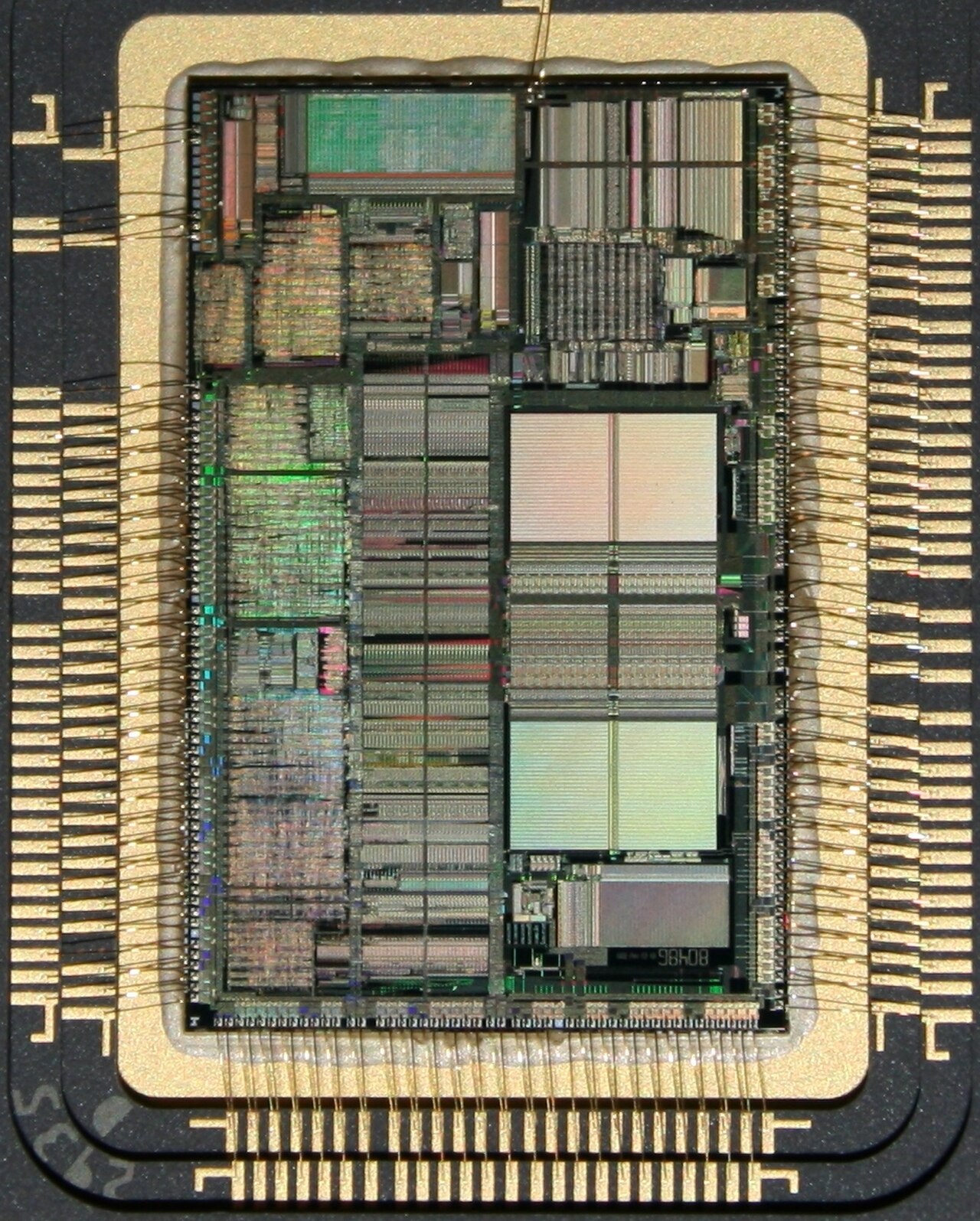
For half a century, 'Moore's Law' was a one-line guarantee: transistors per area double every two years or so, costs fall, and software authors grew used to an endless ride. That transistor curve has now slowed to a crawl, and for most chips the two-year cadence is a historical artifact. Yet AI capability is still compounding. The reconciliation comes from a different, less-cited advantage: algorithmic efficiency.
A widely circulated 2026 preprint ('Scaling is Turing-Complete: The Language of Model Progress') argues that what's actually been driving frontier loss curves since 2020 is not raw transistors but an algorithmic component: the compute needed to achieve a fixed level of loss has been declining faster than Moore's Law ever delivered hardware (Lu et al., arXiv 2603.20021). The authors call this the 'logical compute' pathway — the opposite of the physical substrate pathway.
What 'logical compute' actually means
Physical compute is FLOPS: the raw arithmetic your cards can perform. Logical (or algorithmic) compute is the same outcome achieved with less arithmetic — better data, better loss weighting, better architecture, better inference-time search. Two competing signals drive each of them, and the paper says AI's growth story for the next few years will primarily be a story about the logical signal.
Classical scaling laws — those in the Kaplan-Hoffmann family — assumed loss falls only with more parameters and more tokens. But since roughly 2012 the effective compute to reach a fixed loss has halved roughly every 8-9 months even as mass-produced silicon stalled, a density that would be invisible if you only measured hardware. That is the phenomenon the paper is trying to name.
Hardware isn't going away — but the curve bends elsewhere
| Quantity | What doubles | Cadence |
|---|---|---|
| Moore's law (physical) | transistor and FLOPS density | ~18-24 months |
| Algorithmic efficiency (logical) | effective compute for a fixed loss | ~8-9 months |
| Inference cost per token | useful tokens per dollar | crashing faster than both |
The consequence is arithmetic, not metaphor. If logical efficiency keeps halving every ~8 months while the physical curve flatlines, then a chip-limited future is a different future: each generation of frontier models becomes better not because it uses more silicon but because it needs less for the same result — or, put another way, because every token gets 'smarter' per unit of hardware.
The practical version of this is visible in production budgets. A 2026 survey of inference costs across the major cloud providers found that the price of serving a fixed-capability model has been dropping by roughly an order of magnitude every 12 to 18 months, even as the models themselves got meaningfully better. For teams that re-benchmark their serving stack once a quarter, the savings are structural, not marginal: it is cheaper to re-run a pruning pass and shrink the model than it is to buy another rack.
Why hardware still matters anyway
None of this means chips stopped mattering — it means the bottleneck moved. The paper is careful to note that logical compute does not run in a vacuum: every algorithmic trick still runs on physical silicon, and the frontier of efficiency gains is often gated by how much raw FLOPS researchers have available to experiment with. Distillation, architecture search, and quantization all cost real compute to discover. The efficiency curve is powered by the wastefulness of the frontier, not in spite of it.
That creates a subtle strategic picture. The labs that spend the most on hardware today are the ones generating the algorithmic gains that make tomorrow's models cheaper — and those gains leak out through open weights, papers, and vendor tools. Efficiency is a public good with a private production cost. That is why the gap between the largest labs and everyone else has narrowed even as their compute budgets have grown.
How the curve changes business decisions
For a product team, the 8-month halving changes the buy-versus-build math. A model that is too expensive to serve today will be affordable in two quarters; a custom fine-tune built on an old architecture is usually worse value than waiting one cycle for a cheaper, stronger base. The compounding effect rewards the teams that treat model selection as a subscription rather than a purchase — re-evaluating every quarter against a moving frontier instead of assuming last quarter's choice is still optimal.
It also changes the argument for in-house GPUs. If the cost per useful token keeps falling, the capital-heavy approach of owning a big cluster amortizes worse than renting capacity that continuously benefits from the latest efficiency research. The paper's framing suggests that many of the recent 'AI spending bubble' warnings miss the point: spend is high, but the price of a unit of capability is falling so fast that the inflation-adjusted curve still points down.
'If AI scaling is to remain active, repeated efficiency doublings are not optional. They will be the entire show for most applications' — Lu et al., 2026
Where efficiency comes from today
- Sparse kernels and better token-FLOP blends per watt
- Lower-precision numerics, quantization, and distillation
- Model-wise pruning and architectural search that shrink compute at equal loss
- Better on-chip memory and memory-compute placement that makes FLOPS usable
- Inference-time search: more compute spent at serving time where it buys quality, less at training time where it buys latency
Notice what is missing from that list: more parameters. In the classic scaling-law framing, accuracy was bought with scale — bigger model, more data, more FLOPs. The paper and the surrounding industry have quietly inverted that formula: for a growing share of practical deployments, the same accuracy now comes from better architecture and better use of the tokens, not from a bigger point estimate. That inversion is exactly what 'logical compute' quantifies.
How to read its chart
The preprint's headline figure plots the compute required to hit a fixed benchmark loss across model releases, and shows a clear downward envelope from ~2012 to the present. It overlays two curves: the physical FLOPS available, and the effective compute actually needed once past the 'cleverness' of scaling everywhere. The gap between the two is the paper's contribution. Critics note the loss-benchmark axis is not the same as capability — a model tuned to a fixed loss on one eval can still behave differently on another — but the direction of travel is not seriously contested (Lu et al., 2026).
The bottom line for builders
Does that mean training cost keeps falling?
Partly, but with a twist. Train-flop per token has fallen fast enough that mid-2025 runs cost a fraction of early-2024 equivalents on the same hardware generation. The same forces push inference costs down so much faster that the well-known stat rings true again: an inference request now costs roughly 280x less than it did two years ago, even as models got better.
The twist is that falling unit cost is not falling total spend. The labs spend the saved capacity on frontier compute — more tokens, longer context, bigger evals — which means the efficiency gains show up in quality and reach, not in a smaller electricity bill. That is the same pattern every general-purpose technology follows: price per unit falls, so the total quantity (and spend) grows. The efficiency curve is real, and it is also the reason industry observers keep arguing about whether any of the money is being saved.
The realistic scenario if efficiency stalls
The paper's worst case is not that hardware runs out — it is that the algorithmic delta narrows. If efficiency doublings slow to once a year or worse, then the frontier will start charging the full price of silicon again, and the gap between capable and updated models will widen. The authors treat the 8-9 month cadence as the current empirical rhythm, not a law of nature.
Bottom line for builders
For engineers using these systems, the practical takeaway is that the cheapest durable strategy is to respect efficiency as a real, compounding input — newer distillation, better pruning, more ruthless quantization — because the models you run in 2027 will need dramatically less compute for the same result. The era of counting on every new chip generation to bail you out is over; the era of algorithmic thrift has begun.
Is Moore's Law actually over?
For classical transistor density, largely yes at consumer scale. For AI capability, no — because a cheaper-effective-compute curve ('logical scaling') has been halving roughly every 8 months.
What is algorithmic efficiency?
Getting the same loss or task accuracy with fewer compute resources — via better data, architecture search, quantization, and pruning — instead of just adding more GPUs.
Does that mean GPT-level models get cheaper for consumers?
Mostly yes. Inference prices have fallen on the order of 280x over two years, and the trend is expected to continue as efficiency compounds.
Why does anyone care about 'logical vs physical' compute?
Because it predicts where margins go. If capability comes mostly from algorithms, scale-up chip costs matter less than software, wiring strategy, and data quality.
- Scaling is Turing-Complete: The Language of Model Progress, on arXiv
- Scaling Laws for Neural Language Models, Kaplan et al.
- Training Compute-Optimal Large Language Models, Hoffmann et al.
- Why grounding matters: RAG vs fine-tuning
- The EU AI Act rules that took effect
- Data center energy is becoming a political issue
- DeepSeek is racing the price of AI to zero
Bottom line
For engineers using these systems, the practical takeaway is that the cheapest durable strategy is to respect efficiency as a real, compounding input — newer distillation, better pruning, more ruthless quantization — because the models you run in 2027 will need dramatically less compute for the same result. The era of counting on every new chip generation to bail you out is over; the era of algorithmic thrift has begun.
What we still don't know
This is a fast-moving story. We update the post as new facts land — and we'll flag it when we do.
Enjoyed this? Pay it forward
A sharp story is worth passing on. Share it with the people who read tech like it matters.