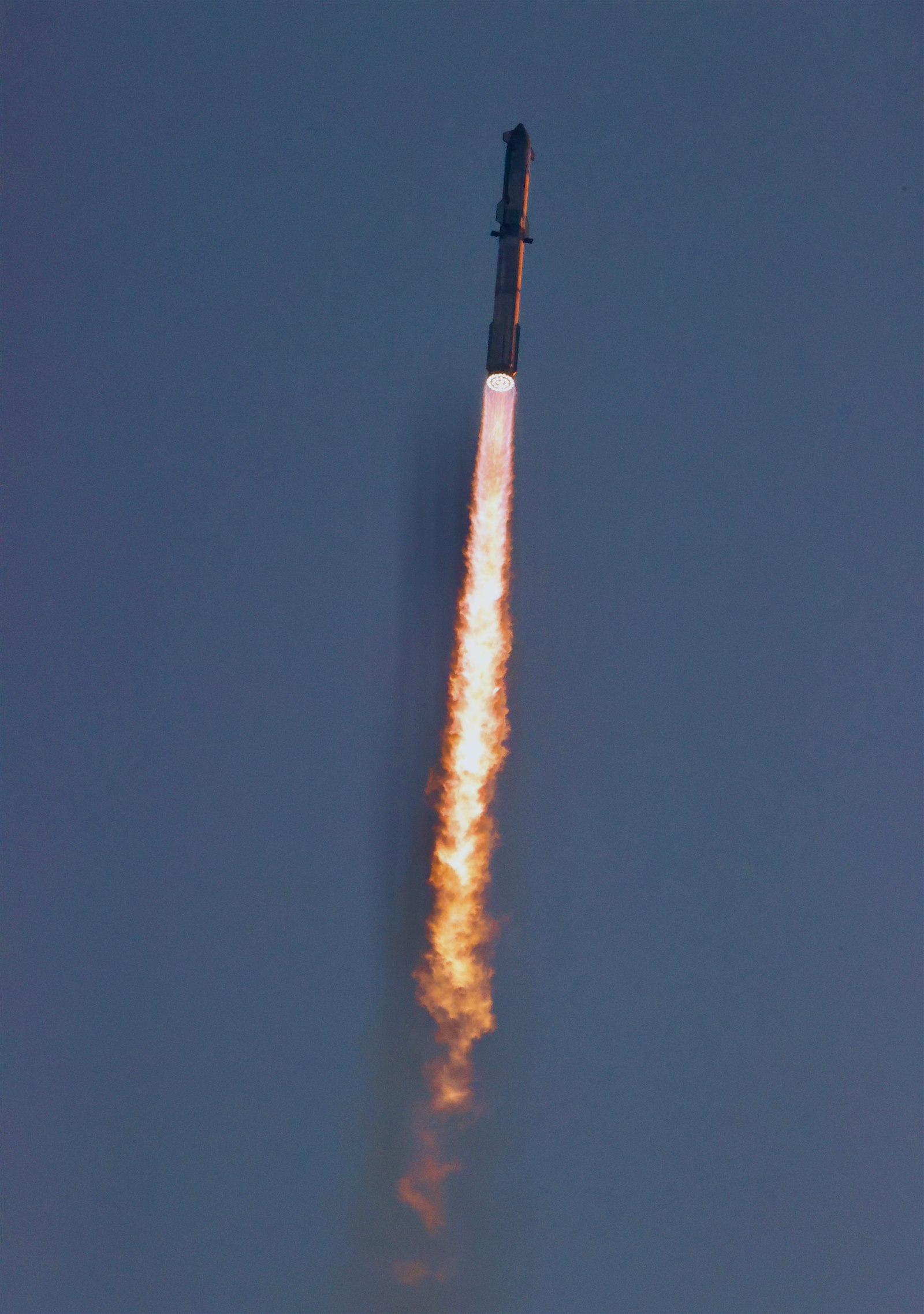
NASA cannot land two astronauts on the Moon for Artemis 3 unless SpaceX fuels one Starship from another in orbit, and that ship-to-ship transfer is still not done as of July 2026. The Block 3 spacecraft that debuted on May 22, 2026 carried real docking hardware, but its first flight was suborbital, not the refueling milestone (Space.com, 2026).
When a Starship reaches low Earth orbit, its tanks are nearly empty. To send the lander to the lunar surface, SpaceX plans to top it up in space from a fleet of tanker Starships. The most-debated number on the program is the tanker count: SpaceX says eight to ten, while NASA has estimated closer to 15 (New Space Economy, 2026).
Why is orbital refueling the one test Artemis cannot skip?
Because a Starship that leaves the pad full cannot reach the Moon on the fuel it carries. The Human Landing System variant burns most of its tank just getting to orbit, and the only way to finish the journey is to refill it there from a propellant depot. Until two ships dock at speed and pump cryogenic methane and oxygen in microgravity, the whole lunar architecture rests on math, not data.
| Estimator | Tanker flights | Source |
|---|---|---|
| SpaceX estimate | 8–10 | New Space Economy, 2026 |
| NASA estimate | ~15 | Spaceflight Now, 2026 |
| Inspector General floor | 11+ | NASA OIG, 2026 |
| Musk (2021, best case) | 4–8 | Wikipedia/SpaceX, 2021 |
The gap between an eight-flight profile and a fifteen-flight profile is not academic. It determines whether SpaceX can plausibly support a lunar campaign cadence or whether the program demands a launch rhythm no rocket program has ever achieved. A single Artemis mission under SpaceX's own depot architecture would require more tanker flights than all Starship launches in the program's history to date (New Space Economy, 2026).
What did the Block 3 flights actually prove?
Flight 12, the Block 3 debut with Booster 19 and Ship 39, launched on May 22, 2026 from a brand-new Pad 2 at Starbase in South Texas. The vehicle reached suborbital space with new external docking adapters and Raptor 3 engines producing 280 tons of thrust each, but the booster did not achieve a soft splashdown and an FAA review followed (Space.com, 2026).
Flight 13 on July 25 was more encouraging. All 33 Raptor 3 engines fired normally at liftoff, generating roughly 9,240 tons of combined force, more than any rocket in history. The booster achieved an on-target splashdown, though it hit the water harder than planned when only 10 of 13 engines restarted during descent (Spaceflight Now, 2026).
The Starship upper stage performed well on both flights. On Flight 13, it deployed 20 third-generation Starlink satellites, re-ignited a Raptor engine in space to demonstrate restart capability, and completed a controlled splashdown northwest of Australia. But neither flight demonstrated the ship-to-ship propellant transfer that the lunar architecture demands (Spaceflight Now, 2026).
How does the tanker fleet actually work?
The mission architecture breaks into three vehicle types. A Starship tanker launches from Earth carrying extra propellant. A Starship depot stays in orbit as a floating gas station. And the HLS lander docks with the filled depot to top off its tanks before heading to the Moon. Each tanker can transfer roughly 200 tons per mission, according to Musk's estimate, though that figure has never been demonstrated in flight (New Space Economy, 2026).
- A Starship configured as a propellant depot launches into orbit and loiters
- Tanker Starships launch in rapid succession, docking nose-to-nose to pump propellant across
- The depot stores cryogenic methane and liquid oxygen for days or weeks while tanker flights accumulate
- Once full, the HLS lander docks with the depot and fills its tanks before departing for the Moon
- Each lunar sortie needs roughly ten tanker transfers to fill the depot (New Space Economy, 2026)
V3 is the first Starship generation built from the start around this architecture. The upper stage carries external docking adapters that allow two ships to rendezvous nose-to-nose in orbit. The tanks hold more propellant than any previous version, and the Raptor 3 engines burn cleaner and weigh less, freeing mass for fuel payload. Without these upgrades, the tanker concept does not work (New Space Economy, 2026).
Raptor 3 makes this possible. The engine eliminates the heat shield that earlier Raptors required, cutting vehicle-side hardware to 1,720 kg compared with substantially heavier figures for Raptor 2 once its shielding was included. Every kilogram saved on engines is another kilogram of propellant that can be transferred to the depot. SpaceX has reached at least serial number 68 on Raptor 3, with more than 300 test firings totaling over 16,000 seconds of cumulative burn time by mid-2025 (New Space Economy, 2026).
The ability to refuel in orbit is the unglamorous part of the Moon program. Without it, even a perfect Starship cannot reach the surface and come home.
— Maya Chen
How hard is pumping propellant in microgravity, really?
Hard in a way that surprises everyone. In orbit, methane and oxygen do not settle neatly; they form a foamy mix of liquid and vapor that sloshes with no gravity to pin it down. SpaceX already moved propellant between two tanks on the same vehicle during an earlier flight test, a necessary step, but moving between two vehicles at high closing speeds is a different challenge.
The propellant has to stay cold enough to remain liquid throughout the entire tanker campaign. Cryogenic boiloff is relentless in space, and the launches need to happen fast enough that the depot does not lose its cargo before the last tanker arrives. The GAO has flagged this cryogenic fuel management as a top risk for the program (Spaceflight Now, 2026).
| Spec | V3 | V2 |
|---|---|---|
| Height | 124.4 m | 123.1 m |
| Raptor 3 thrust per engine | 280 tons | 230 tons (Raptor 2) |
| Chamber pressure | 350 bar | ~300 bar |
| Payload to LEO (reusable) | 100+ tons | ~35 tons demonstrated |
| Payload to LEO (expendable) | 180–200 tons | Not flown to orbit |
| External docking adapters | Yes | No |
Will the propellant transfer test happen before Artemis 3?
Not before a crewed landing, under the current plan. NASA rewrote Artemis 3 in February 2026 to perform a rendezvous-and-transfer test in Earth orbit before any first crewed landing, pushing that landing to Artemis IV in early 2028 (New Space Economy, 2026). That buys SpaceX time to mature the depot, but it also moves the first landing further out.
The revised plan is pragmatic. Interim NASA administrator Sean Duffy in late 2025 directly characterized SpaceX as behind on HLS and reopened aspects of the contract to competition from Blue Origin. Artemis 3 will now test docking with both a Blue Origin Blue Moon lander and a modified Starship in low Earth orbit, giving crew practice with the procedures they will eventually need in lunar orbit (Spaceflight Now, 2026).
What happens if the transfer test keeps slipping?
Artemis slips with it. The GAO calls propellant management a top risk for the program and has flagged SpaceX as more than a year behind its own schedule on key milestones including the critical design review, the long-duration propellant transfer demonstrations, and the uncrewed lunar landing test (Spaceflight Now, 2026). Every delay adds more tanker flights to an already demanding depot plan and pushes the first landing further toward the end of the decade.
There is also a production tempo problem. Heat shield manufacturing at SpaceX's Cape Canaveral facility reached 1,000 tiles per day by early 2026, with a designed capacity of 7,000 per day. That is enough to refurbish roughly 10 Starships monthly. But the tanker campaign demands a launch cadence that has never been demonstrated with any rocket, let alone a vehicle as complex as Starship (New Space Economy, 2026).
How does Blue Origin fit into the picture?
Blue Origin's New Glenn rocket and Blue Moon lander represent the backup plan. The company was preparing New Glenn's third flight in April 2026 and planned an uncrewed Blue Moon Mark 1 lunar demonstration in the same year, a timeline some analysts now consider competitive with SpaceX's own HLS schedule. If Flight 12 slips further or Flight 13 delivers another vehicle anomaly, the Blue Moon Mark 2 lander becomes a credible candidate for Artemis IV (New Space Economy, 2026).
Blue Origin also needs orbital refueling for its lander, but its architecture requires fewer tanker flights because the vehicle is smaller. The contrast matters: NASA hedged its bets by awarding contracts to both SpaceX and Blue Origin, and the GAO's skepticism about SpaceX's timeline has given Blue Origin political cover to catch up (Spaceflight Now, 2026).
So is Starship refueling the real bottleneck?
Yes. The rocket works; the refueling does not yet. A lot of attention goes to Raptor engines and booster catches, but the deciding test is pumping fuel between two Starships in low Earth orbit. Until that test records clean data, every Moon timeline is a hope, not a plan.
V3 makes the tanker architecture theoretically possible. The docking adapters, the larger tanks, and the Raptor 3 performance margin are all prerequisites for a working depot. But making it work at the cadence a lunar campaign demands, eight to fifteen tanker flights per crewed mission, plus the HLS flight itself, plus contingency, is an order of magnitude beyond what SpaceX has demonstrated. In 2025, the Starship program flew five times. A single Artemis mission under the depot architecture would require more tanker flights than all Starship launches in the program's history (New Space Economy, 2026).
The next 18 months will determine whether V3 becomes the backbone of American deep-space operations or a transitional design superseded by a further iteration. Flight 13 showed the vehicle can fly and deploy payloads. The question now is whether it can refuel itself in orbit, and whether SpaceX can do it fast enough to put astronauts on the Moon before the end of the decade.
- Space.com — What's next for Starship V3
- Spaceflight Now — Flight 13 flight report
- New Space Economy — Starship V3 deep review
- Wikipedia — Starship HLS
- NASA — Artemis III mission overview
- The lunar economy: mining the Moon gets serious
- Fusion breakthrough reality check
- Roman Space Telescope launch timeline
Bottom line
The next 18 months will determine whether V3 becomes the backbone of American deep-space operations or a transitional design superseded by a further iteration. Flight 13 showed the vehicle can fly and deploy payloads. The question now is whether it can refuel itself in orbit, and whether SpaceX can do it fast enough to put astronauts on the Moon before the end of the decade.
What we still don't know
This is a fast-moving story. We update the post as new facts land — and we'll flag it when we do.
Enjoyed this? Pay it forward
A sharp story is worth passing on. Share it with the people who read tech like it matters.