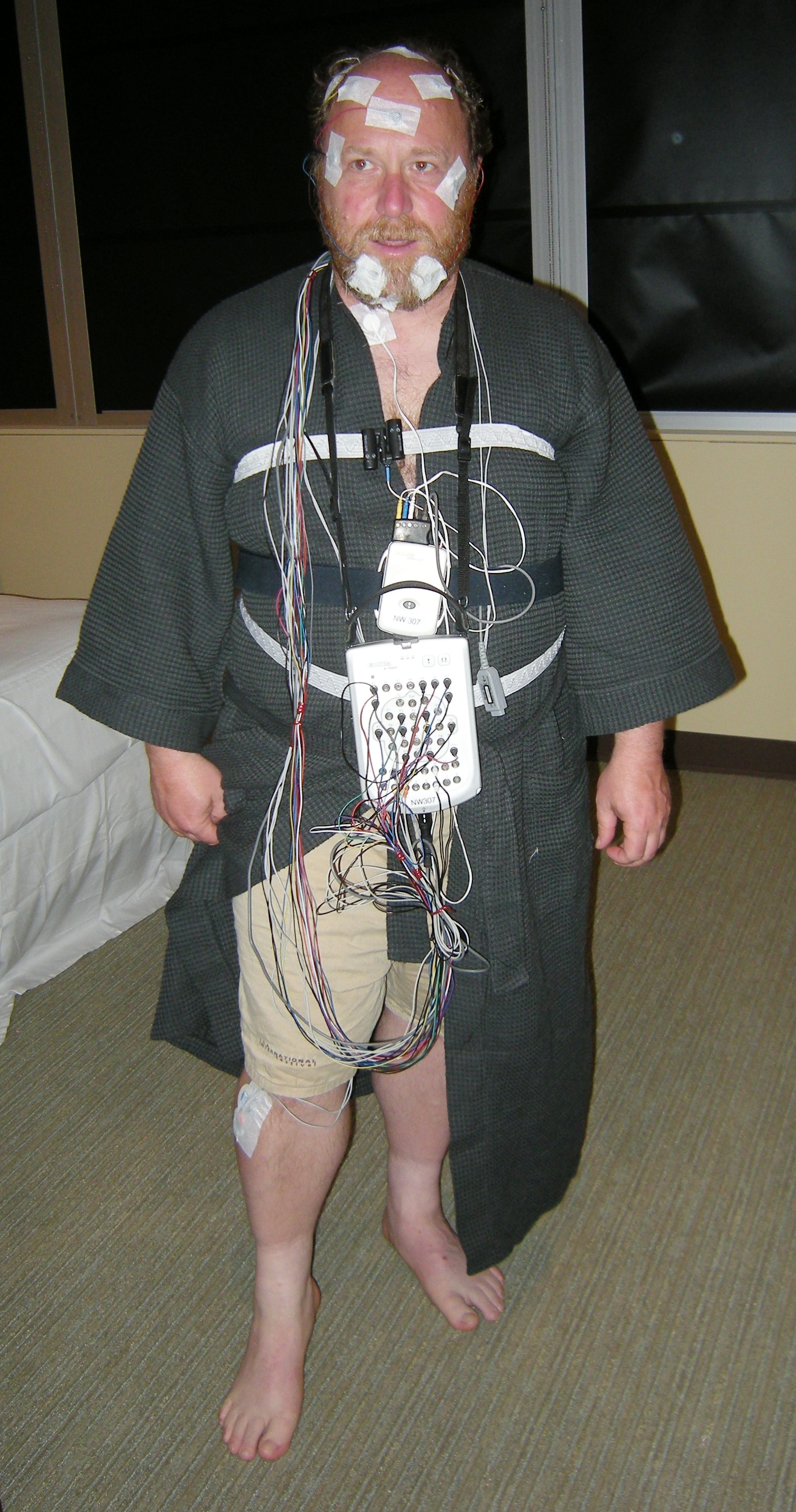
A new paper in Nature Communications trained an AI foundation model on more than 10,000 clinical sleep recordings and used it to sort patients into five sleep risk groups, one of which carries more than double the mortality risk of the healthiest (Nature Communications, 2026). It joins a wave of sleep AI that is turning overnight lab data from a clinical formality into a mortality predictor. Here is what the study actually shows and what it does not.
Key takeaways
- The model was trained on 10,000+ polysomnography recordings, the clinical gold standard for sleep.
- It sorts sleepers into five phenotypically distinct risk groups.
- The highest-risk group carries more than double the mortality risk of the healthiest.
- Other sleep models, like SleepFM, cover 130 sleep-related conditions from 585,000 analyzed hours.
- This is predictive signal, not a diagnosis tool, and the leap to consumer wearables remains unproven.
What a sleep foundation model actually is
Sleep scoring used to be a person in a booth reading a paper strip. The raw signal from a sleep study, the polysomnogram or PSG, has channels for brain waves, eye movement, muscle tone, breathing, and oxygen. A foundation model takes that multi-channel signal and learns general patterns from thousands of nights, so a doctor can ask it questions about a single new patient without retraining on a custom dataset (Nature Communications, 2026).
The name is borrowed from large language models: train once on a massive corpus, then adapt to many tasks. For sleep, the "tasks" are detecting apnea, staging sleep, flagging oxygen dips, and now grouping whole patients by risk. That is why this paper is covered as a breakthrough even though it is one step in a longer research line: it makes a single model the Swiss army knife of overnight medicine.
The five sleep risk groups, decoded
| Group | Profile | Mortality risk |
|---|---|---|
| Group 1 | Healthy, efficient sleepers | Baseline |
| Group 2 | Young, mild fragmentation | Slightly elevated |
| Group 3 | Moderate apnea signal | Elevated |
| Group 4 | Severe oxygen dips | High |
| Group 5 | Combined apnea plus hypoxia | More than 2x baseline |
The grouping is the headline because it collapses dozens of night-level measurements into five labels a clinician can act on. Groups 1 and 2 describe sleepers most doctors already treat as normal. Groups 3 and 4 carry real warning weight. Group 5, the group with both breathing interruptions and sustained low oxygen, is where the mortality signal concentrates (Nature Communications, 2026).
Think of it as a triage bucket: the model does not say why a sleeper is in Group 5, but it says which patients deserve the next round of testing and monitoring, and it says it better than any single manual metric did on its own. That is the clinical contribution of the paper.
How the 10,000 nights were gathered
The training set is large for sleep science but small by AI standards, roughly 10,000 clinical PSG recordings drawn from a mix of cohorts. The value is the rigor: these are gold-standard lab nights with expert-annotated sleep stages, not consumer data from a wristband guessing REM by your pulse. Clean labels are what make the learned patterns reliable (Nature Communications, 2026).
Because the recordings come from a patient population, the model sees pathological sleep far better than a consumer dataset would. That is both a strength and a caveat: it is tuned to what happens in a sleep lab, and how it behaves on everyday wearable signals is a different question the paper does not fully settle.
Why the mortality link matters
Sleep apnea has a long-documented association with cardiovascular disease, and the new work strengthens the quantitative link by pairing lab-grade sleep phenotypes with follow-up mortality. The five-group structure gives researchers a handle, "high-risk sleep pattern," that can feed population studies the way blood pressure categories feed cardiology (Nature Communications, 2026).
The caution is that this is association, not experiment. Sleep is correlated with weight, age, and comorbidities, and the paper adjusts for known confounders but cannot remove them all. The honest framing is that the signal is real and reproducible, and the next step is interventional trials testing whether treating Group 5 patients lowers their risk curve.
Where this fits the bigger sleep AI wave
This paper is one of several 2025-2026 foundation models in sleep medicine. SleepFM, published in Nature Medicine, trained on 585,000 analyzed hours across 130 sleep-related conditions and hit strong classification performance. The difference from the new work is the output: SleepFM focuses on condition recognition, while the Nature paper lands on phenotypic risk grouping tied to mortality (Nature Medicine, 2026).
Together they move the field from "we can score a night" to "we can stratify a person." That trajectory is what makes researchers optimistic that sleep will become a routine screening input in preventive care, similar to how cheap imaging changed preventive scanning, rather than a last-resort luxury test.
The wearable question nobody can answer yet
- Consumer devices track movement and heart rate, not brain-wave sleep staging.
- The gap is the EEG channels; wearables estimate but do not measure them.
- Some smartwatches now approximate respiratory disturbance, not apnea severity.
- Until sensors improve, lab PSG remains the only full picture.
The moment someone asks "can my watch tell me my risk group?" the honest answer is no. The model needs the multi-channel PSG signal, and the typical smartwatch has no EEG and a single photoplethysmography channel for the heart. Wearable companies are closing the gap with larger batteries and better motion models, but they are predicting sleep, not measuring it.
That does not make wearables useless. They remain excellent at routine and trend line: when your sleep history shows a month of rising fragmentation, the signal to book a lab study is real. The failure mode is converting a good watch score into a medical conclusion, which the five-group model explicitly does not support.
What the researchers say it is not
The authors are careful that the model is a research and risk-stratification tool, not a diagnostic device. It does not replace a physician, does not label individual patients as "dying," and should not be marketed as home health scoring. The purpose is exactly what a triage score does: order the waiting room and tell the clinician whom to look at first (Nature Communications, 2026).
The same care applies to the media coverage. A headline that reads "AI predicts death from sleep" overshoots the finding; the accurate phrasing is "an AI sleep phenotype carries an elevated, statistically significant mortality association." The difference sounds pedantic until a worried patient reads the headline and panics about their watch.
When you should actually seek a sleep study
- Loud, disruptive snoring that has been going on for years.
- Daytime sleepiness severe enough that you fall asleep while seated or driving.
- A bed partner who has watched you stop breathing or gasp during the night.
- Symptoms coordinated with blood pressure issues your doctor has flagged.
The clinical threshold has not changed because of the paper. A sleep study is indicated when apnea symptoms, unexplained fatigue, or risk factors like high BMI and hypertension justify the cost and the night in the lab. What the new model changes is what happens after: the five-group label can push a borderline patient toward treatment faster than a raw apnea index alone.
If you get a prescription for a home sleep test, it is still the right first step, and it measures the breathing channels that matter most for apnea. The full in-lab PSG remains the gold standard for the brain and limb channels the home kits skip, which is exactly the signal the new model depends on.
What comes next for sleep medicine
The research roadmap is clear: prospective validation in new cohorts, interventional tests on Group 5 patients, and eventually a consumer-grade sensor that produces enough signal for the model to run outside the lab. Each step is slow on purpose, because a mortality predictor marketed early is how the entire field loses trust with regulators and patients.
For the rest of us, the practical upgrade is awareness. Sleep stopped being a lifestyle topic and became a first-order health variable, and studies like this one repeatedly tie poor sleep to measurable outcomes. The five risk groups are a research artifact today, and a screening conversation tomorrow, which is the direction every big sleep study of 2026 points.
The people who should read this study twice
Three groups get outsized signal from the finding. People with hypertension who snore, people who wake gasping, and anyone whose bed partner reports breathing pauses should treat the paper as a nudge, not a verdict, toward a lab sleep study. The model groups those symptoms into the higher-risk clusters, and an apnea diagnosis can now come with a quantified severity anchor (Nature Communications, 2026).
The rest of the population should read it once for calibration. A single bad night, or even a week of bad nights, does not put you in Group 5, the paper is describing persistent physiological patterns across thousands of recorded hours. The study is about clinical sleep, not about the night you scrolled past midnight, and conflating the two is how the research gets misused as a scare headline.
Frequently asked questions
What did the new sleep study find?
Researchers trained an AI model on 10,000+ clinical sleep recordings and sorted patients into five risk groups, with the top-risk group carrying more than double the mortality risk of the healthiest.
Can my smartwatch tell me my sleep risk?
Not reliably. Watch sensors estimate sleep from movement and heart rate, while the model needs the multi-channel brain-wave and breathing data of a full sleep study.
How is this different from SleepFM?
SleepFM focuses on recognizing sleep conditions from 585,000 hours of data, while the Nature Communications model groups whole patients into mortality-associated phenotypes.
Should I get a sleep study after reading this?
If you have loud snoring, daytime sleepiness, observed breathing pauses, or hypertension with sleep complaints, ask your doctor. The study changes triage, not the referral indications.
Related coverage
- Why multitasking really costs your brain
- The science behind sugary drinks and your body
- Why cracking your knuckles is (mostly) fine
- Premedice: a free AI symptom checker for lab results
- The state of consumer medical AI in 2026
- Nature Communications: sleep foundation model paper
- SleepFM: a foundation model for sleep medicine
- NIH: what to expect during a sleep study
Bottom line
The rest of the population should read it once for calibration. A single bad night, or even a week of bad nights, does not put you in Group 5, the paper is describing persistent physiological patterns across thousands of recorded hours. The study is about clinical sleep, not about the night you scrolled past midnight, and conflating the two is how the research gets misused as a scare headline.
What we still don't know
This is a fast-moving story. We update the post as new facts land — and we'll flag it when we do.
Enjoyed this? Pay it forward
A sharp story is worth passing on. Share it with the people who read tech like it matters.